
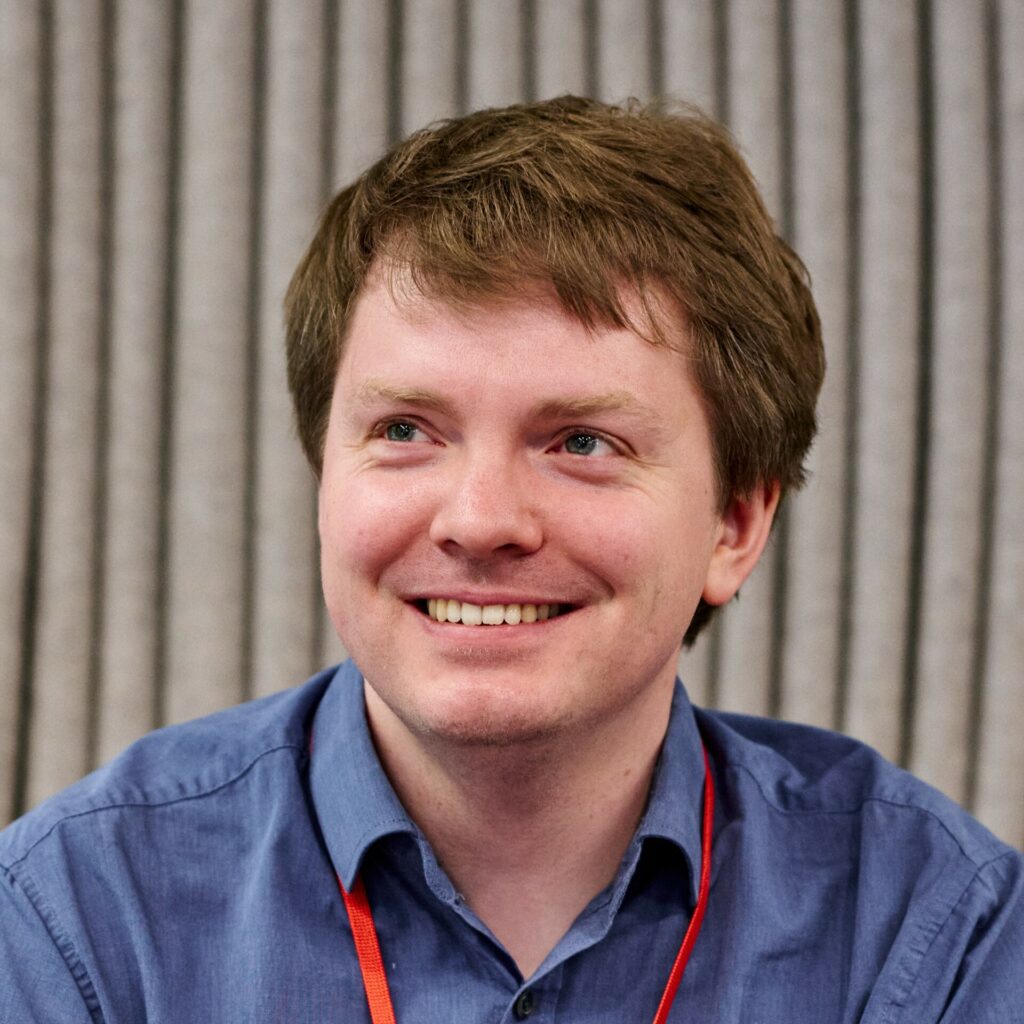
This newsletter’s Stempra Star is Alex Durk – Communications Manager at Springer Nature
What is your job and how did you get there?
I’m a communications manager at Springer Nature, the major research publisher. I work in the Journals and Editorial Communications team, primarily promoting research that is published in our journals to the global news media, but also providing support for the journals when they receive media enquiries from journalists (usually on research integrity topics). I’ve been at Springer Nature now for about 18 months after four years at the Science Media Centre, where my first steps in sci comms were a real baptism of fire during the peak of the pandemic — very long days, hurried exchanges with journalists desperate for any help at all, pleading emails to hundreds of scientists hoping someone had a little free time somewhere, but also more job satisfaction than I think I could have hoped to have during such circumstances. During my time at the SMC I also helped somewhat with the editing and fact-checking of Fiona Fox’s book, Beyond the Hype, and ran the internship programme. Before my real career started, I’d followed a physics degree with two years of running my college’s bar at Durham University, which gave me a real crash course in managing my own time at work.
Describe a typical day
Email heavy! We’re still a team doing a lot of work over email, and there’s a healthy amount each day of email reading, email writing, and email filing with fingers crossed that the problem is now actually sorted. Beyond that, no two days are the same but there are common themes. Most days I’ll skim read several papers that we haven’t yet published, trying to work out if we should be promoting them. Every day has some writing involved, whether that is a press release, a statement for a journalist, or a script for a video in the series we started last year highlighting open access research we’ve published. Working in such a large company, there’ll be some collaboration or communication with another team, quite possibly in another country — an editor who wants feedback on the newsworthiness of a paper, a member of the Research Integrity Group explaining the key points of their work on a particular case, or asking a colleague with a much better knowledge of another country’s media if they’ll be at all interested in a paper we’ve seen. Finally, the work with people outside the company — trying to get a journalist to cover a story about an algorithm that can identify notes in whisky, working with an excited author on the promotion of a paper that’s taken several years to come to fruition, or helping other comms professionals negotiate the complex and confusing behemoth that we can often appear to be.
Most rewarding aspect of your job?
I’m still a little excited every time I see a good, well-written news story about some research I’ve helped promote. Sometimes it’s on the softer side, like the whisky example above, but it’s particularly rewarding when a more complex and contentious story gets good coverage from a broad spectrum of news outlets across the world. Seeing research that I believe will make an impact on people’s lives in the long run being reported on responsibly because of my press release is always a wonderful feeling. I should also flag here that, clichéd as it is, being a part of a great team is worth its weight in gold. I feel lucky to work in a team where the news media, and by extension the public, are still considered a key audience, and where we still have support from senior colleagues to do this job. Coming from the SMC, I was worried of ending up in a comms team where they believed “science and the media does itself”. I don’t believe that’s ever true for responsible science journalism, and I really feel I’ve fallen on my feet in a supportive team of colleagues who all passionately believe that the work we do is genuinely beneficial for the public and science.
Also, I still get to play around with spreadsheets a little to make our working lives easier and more efficient — neat Excel formulae remain a slightly guilty pleasure!
Hardest bit of your job?
Crafting statements for journalists about research integrity cases in our journals. My instinct as a communicator is to be as open as possible when discussing difficult issues, and research integrity cases which attract media interest are almost inevitably difficult and contentious. However, in my first job working for a large corporate organisation, I have had to learn quickly to balance my instincts for openness with the expectations and realities of what we can actually provide to journalists — which is, frequently for legal or confidentiality reasons, usually less than the information included in my first draft! I’m indebted to my senior colleagues who have more experience working on these tricky reputational issues and provide extensive advice and support. Ultimately though, despite these difficulties, it is rewarding to work for an organisation where the integrity of the scientific record is considered to be of great importance and worth protecting, even if it occasionally means the organisation’s reputation may take a minor hit.
Tell us about an interesting/challenging case study/project you have recently worked on?
Two climate papers from last year come immediately to mind — one discussing the growing impact of private planes on climate change, and one suggesting that a reduction in shipping emissions may have had an inadvertent geoengineering effect. Climate science is a topic I tend to find extremely interesting, but getting the key details out of a dense modelling paper can prove challenging. The first paper seemed an immediate news hit to me, whilst the second was a much trickier sell, but I thought both were really important topics that really needed responsible coverage — and therefore a responsible press release. There were some hours spent getting the nuances of the research correct, and for both papers the press release went back and forth between authors, editors, and our team making sure that everyone was satisfied. Ultimately, I was very pleased with the coverage of both papers, as were the authors. Plus, it was nice to get a roundup from the SMC for a press release I’d written (and for the comments to not eviscerate what I’d written, which I’ll admit I was a little afraid of!).
Most bonkers thing you’ve done in the name of science communication?
There’s not been too many weird things yet – perhaps six years is not long enough for anything truly bizarre to occur. Top of the list may be surreptitiously letting Neil Ferguson into Wellcome via the fire exit after he’d rushed over in a taxi from No. 10 to sit on an SMC briefing panel (specifically the now-infamous March 16th 2020 briefing where they announced the potential Covid death toll without lockdown). The lift wasn’t available so we ran up five floors together as he was already late for the planned start. Unbeknownst to either of us, he was asymptomatic with Covid at the time — he only found out on testing the next day. Given the real lack of knowledge of the disease at that time, and the scary images coming out of Italy and China, it felt at the very least quite risky in hindsight!
Any advice for anyone wanting to follow in your footsteps?
First, develop your news sense as much as possible as early as possible! Identifying potential news stories is an art not a science, as we frequently tell the editors of our journals, but it is something you can train and it will help immeasurably. AI is still not good at spotting what makes a paper newsworthy, so there’s mileage in the skill yet!
Second, embrace the opportunity to do things that you’re inexperienced at (or just not great at yet!). I’m a big believer in learning by doing, and in finding out what your limits are organically. I think that failure because it turns out the project was something you genuinely couldn’t do for whatever reason — skill, workload, competing interests from people you’re collaborating with — is a better look, and a better learning experience, than refusing to try something because you think you’ll fail.
Finally, treat journalists as friends wherever and whenever you can. We have the benefit of working in a communications field where journalists are usually looking to write nice stories rather than hatchet jobs — working closely and helpfully with them on those nice stories can help mitigate the difficulties when they do cover the thornier topics.