
This newsletter’s Stempra Star is Amy Shergold who is Senior Research Communications Officer at Breast Cancer Now
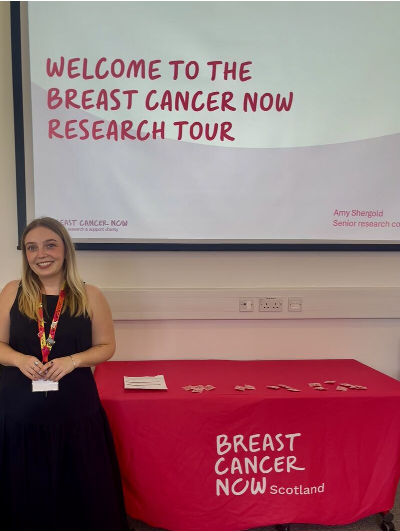
What is your job and how did you get there?
I am the senior research communications officer at Breast Cancer Now.
In a previous life I was studying for my PhD in cancer immunology. I loved learning, talking, and thinking about science. What I didn’t love was actually doing the science. The lab life wasn’t for me. After a lot of networking and soul-searching, I decided to explore careers that played to my strengths and choose something that suited me better.
A silver lining of the COVID lockdowns was that I fell into science communication almost by accident. I did what everyone does during moments of crisis – I started a podcast. This reignited my passion for sharing science with others and I continued to build a portfolio of volunteer communication and engagement projects while finishing my PhD.
My networking then led me to paid work with a research centre and a new cancer charity, where I expanded my skills in copywriting, stakeholder engagement, and public involvement. That mix of experience, combined with my scientific background, ultimately led to my current role at Breast Cancer Now.
Describe a typical day
No two days look the same, which is something I loved about being a researcher and have carried into my science communication career. Most days, I’m reading research and creating bespoke reports that translate the complex science into accessible stories.
I also support press and PR teams by reviewing publications, spotting newsworthy studies, and helping develop media content. On some days, I host talks for staff, supporters, and service users, sharing the impact of our research and answering questions about the science behind it. Every so often, I attend science conferences and keep up to date with the hot topics in research.
Most rewarding aspect of your job?
Chatting with our supporters and service users is the most rewarding part of my job. Answering their questions and seeing their curiosity grow reminds me why science communication matters.
I also love the variety of science I encounter. During my PhD, the focus of the science narrowed over time, and I really missed the breadth of learning I had as a student. Now I get to dive into a wide range of topics, which has helped me fall back in love with science (and collect lots of science fun facts along the way!).
Hardest bit of your job?
Supporting press and PR by reviewing publications is one of my favourite parts of the role, but also one of the most challenging. I often need to quickly understand complex research outside my own expertise, then translate it accurately and engagingly under tight deadlines. It’s the kind of work that definitely calls for a second cuppa coffee.
Tell us about an interesting/challenging case study/project you have recently worked on?
Outside of work, I co-created a project that brings science engagement into prisons. We organise and host sessions for incarcerated learners, connecting them with researchers and supporting them to make informed health decisions and be able to critically analyse scientific information. For the researchers, we provide an opportunity to engage with an audience that’s usually excluded from science communication.
Working within the constraints of the prison environment has challenged us, and our volunteers, to design creative, interactive sessions without traditional science engagement materials. With the learners, we’ve had fascinating and unexpected conversations that have strengthened my confidence in communicating a wide range of science on the spot.
Most bonkers thing you’ve done in the name of science communication?
My friend and I have a group chat dedicated to sharing interesting statistics (like an emergency science comms kit) so we’re always ready for any impromptu science conversation. Some might call this bonkers, but we like to think of it as forward thinking.
Any advice for anyone wanting to follow in your footsteps?
When I first considered leaving academia, I had no clear idea of my next step. I didn’t know many people who had made the leap into careers I could see myself doing. Even now, I’m still discovering paths I didn’t know existed. The most helpful thing I’ve done is build a network of people I can learn from. At conferences and work events, I challenge myself to talk to at least one new person. I like to ask them about their career journey, and I follow them on LinkedIn so I can keep learning from their work.
This approach has opened up unexpected opportunities and helped me understand what I enjoy, and what I don’t, so I can plan my next move. Networking also led me to finding a mentor who helps me reflect on my skills and interests.
So overall, my advice is to seek out to learn from people with diverse career paths. And allow yourself to try opportunities even outside your target field. Every experience builds transferable skills and helps you carve your own path by learning what is for you and what is not.